
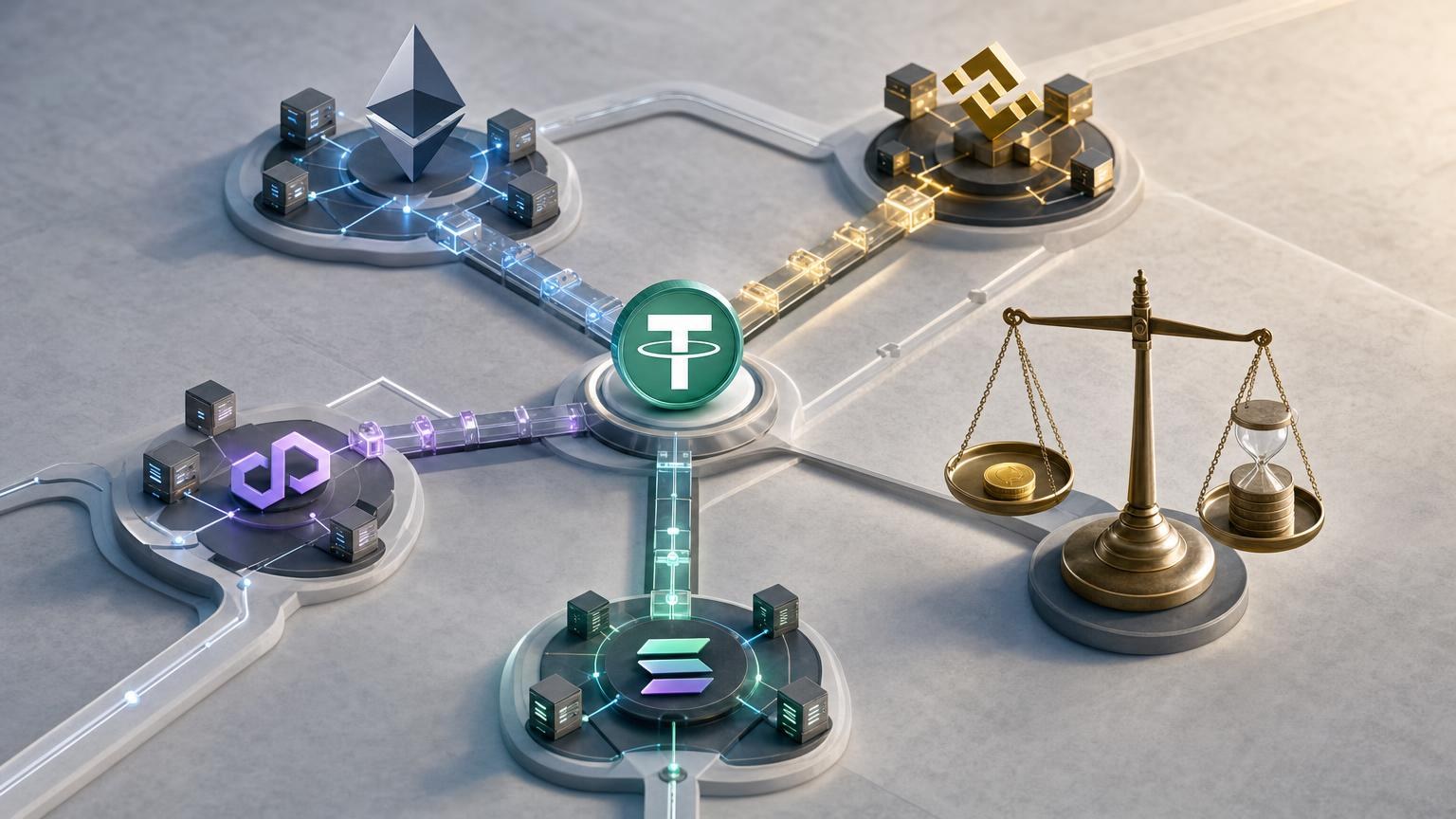
The same USDT amount can produce different exchange costs because USDT is issued on multiple blockchains, while each blockchain has its own fee mechanism. The exchange service may also incorporate network expenses and operational costs into its quote. This analysis explains the technical reason for the difference; it does not claim that a particular network will always be cheaper or that every network is available for every exchange direction.
How the claims were checked
Technical claims were matched against primary materials from Tether, Ethereum, and TRON. Issuer documentation was used to establish that USDT exists on separate protocols. Blockchain documentation was used for fee mechanics. Source freshness was treated separately from live conditions: a recently updated technical page can explain how fees work, but only a current order quote and current blockchain data can show the cost of a specific transaction.
No fixed fee figures are presented because network conditions, chain parameters, account resources, and exchange pricing can change. The service’s exact fee formula has not been supplied, so any breakdown of a particular quote would be an assumption rather than a confirmed fact.
Why the network changes the cost
USDT on Ethereum and USDT on TRON may represent the same reference asset, but they are separate tokens recorded on separate ledgers. Tether’s integration guidance lists USDT implementations on multiple protocols and stresses that platforms must make their supported protocols explicit. Issuer support does not automatically mean that a particular wallet, exchange, or exchange direction supports the same network. [1]
Each network charges for a different type of underlying resource:
- Ethereum: a transaction consumes gas. The fee is based on the gas used and the price per unit of gas, and it is paid in ETH. The base fee and priority fee respond to network conditions, while a token transfer involves smart-contract execution rather than the simpler mechanics of sending native ETH. Higher demand can therefore raise the cost of moving ERC-20 USDT even when the USDT amount itself has not changed. [2]
- TRON: transactions consume Bandwidth, while smart-contract calls also consume Energy. Available resources may come from account quotas, staked or delegated resources, or a fallback charge in TRX. The relevant chain parameters can be changed, so an old estimate should not be treated as a permanent tariff. [3]
This leads to an important distinction: the blockchain fee is determined by the selected network’s rules, while the exchange quote is determined by the service. A service may pay the on-chain withdrawal cost itself and recover it through an explicit charge, the quoted exchange rate, a fixed withdrawal amount, or another disclosed pricing component. Without the service’s current order terms, the exact allocation is unknown.
What an exchange quote may contain
A useful conceptual calculation is:
Estimated amount received = converted input amount − disclosed service charges − disclosed withdrawal or network charge.
This is an explanatory model, not a statement about the pricing formula of a specific service. Some interfaces show separate lines; others show only the amount to be sent and the amount expected at the destination. Compare the final amount received rather than relying only on a label such as “low network fee.” Also check whether the quote is fixed for a stated period or can be recalculated before processing.
The transaction amount may affect a provider’s commercial fee or minimum, but it does not necessarily change the underlying blockchain cost in direct proportion. On Ethereum, for example, gas reflects computation and the current gas price rather than simply applying a percentage to the USDT value. [2]
Claim Registry
| Claim | Status | Primary source type and name | Publication or update date | Limitation | What could change the conclusion |
|---|---|---|---|---|---|
| USDT operates through multiple blockchain protocols, so selecting “USDT” alone does not identify the transfer rail. | Confirmed | Issuer integration documentation: Tether Supported Protocols and Integration Guidelines [1] | No visible update date on the cited page | Tether’s protocol list does not prove that a particular exchange or wallet supports every listed network. | Tether may change protocol support, while platforms may add, suspend, or remove individual networks. |
| Ethereum transaction costs depend on gas usage and the current price per unit of gas. | Confirmed | Protocol education documentation: Ethereum.org Gas and Fees [2] | June 24, 2026 | The documentation explains the mechanism, not the live cost of a future ERC-20 USDT transfer. | Network demand, the selected priority fee, transaction execution, and protocol upgrades. |
| A TRON USDT transfer may consume Bandwidth and Energy or trigger a TRX charge when available resources are insufficient. | Dependent on conditions | Protocol developer documentation: TRON Resource Model and Paying for Resources [3] | Updated in September 2026; the pages displayed relative update notices rather than calendar dates | The result depends on the sending account’s resources, the contract operation, resource delegation, and current chain parameters. | Account state, governance-approved parameter changes, contract resource use, and dynamic Energy rules. |
| The network with the lowest raw blockchain charge always produces the best exchange result. | Not established | Protocol documentation describes blockchain costs but does not establish an exchange provider’s pricing formula. | Not applicable | A quote may also reflect the exchange rate, service charges, liquidity, routing, operational costs, and available direction. | The live order quote and its disclosed terms. |
| The exact USDT exchange fee can be known before opening a current order. | Unknown from the supplied evidence | No primary source for a specific live quote was supplied. | Not applicable | No verified fee, limit, rate, or supported-network data for a particular order is available in this analysis. | The current order screen, selected assets, amount, destination network, and applicable compliance requirements. |
How to compare networks step by step
- Start with the receiving platform. Check the exact USDT deposit network it currently supports. Do not choose a network merely because its address format looks familiar.
- Match the network at both ends. The withdrawal network in the exchange request must be the same protocol as the recipient’s deposit network. “USDT” appearing on both screens is not sufficient confirmation.
- Copy the address from the destination. Avoid addresses received through unsolicited messages, advertisements, or support accounts on social media.
- Check the full quote. Record the input amount, expected output, network, exchange rate, disclosed charges, and any warning that the amount may be recalculated.
- Compare net delivery. If more than one compatible network is available, compare how much USDT is expected to reach the wallet, not only the stated blockchain fee.
- Verify limits and compliance conditions. Requirements may depend on the exchange direction and the results of compliance checks. Confirm the current conditions before creating the request.
- Recheck before payment. Make sure the asset, network, address, amount, and displayed terms have not changed between quotation and confirmation.
Safety risks that matter more than a small fee difference
Wrong network or address: sending USDT through a protocol the receiving platform does not support may prevent automatic crediting and can lead to permanent loss. Tether specifically warns users to confirm the correct transport protocol when transferring its tokens. [4]
Limited reversibility: cryptocurrency payments typically cannot be reversed through the protections available for card payments. Recovery may depend on the recipient or platform being able and willing to return the assets. [5]
Phishing: verify the domain and open the service independently instead of following an unexpected email, messenger, or social-media link. The FTC warns against clicking links in unsolicited messages and notes that fake crypto websites and wallet instructions can appear convincing. [5]
Changing support: protocol status is not permanent. Tether’s current documentation distinguishes supported implementations from deprecated ones, and its legal terms allow support for a blockchain or protocol to cease. [1]
Jurisdictional differences: access rules, identity checks, reporting obligations, and consumer protections vary by country. Confirm the rules applicable to your location rather than treating another user’s experience as authoritative legal or tax guidance.
Procedure for rechecking dynamic information
- Confirm the receiving wallet’s network immediately before creating the request.
- Check the current network status in the relevant official documentation and blockchain explorer.
- Generate a fresh quote instead of relying on a screenshot or an earlier request.
- Read the order terms to determine whether the exchange rate is fixed or floating and where charges are reflected.
- Verify the destination address character by character at the beginning and end, and use the complete address rather than a shortened display where possible.
- For a new wallet or unfamiliar route, consider whether a small test transfer is supported and economically reasonable; this reduces operational exposure but creates an additional fee and does not eliminate risk.
- Stop if the displayed network, address, or expected output changes unexpectedly.
The practical conclusion is limited but clear: network selection changes the technical cost basis of a USDT transfer, yet the cheapest blockchain at a given moment is not automatically the cheapest exchange route. Compatibility and the final quoted amount should be checked together.
After comparing the technical conditions, use the service interface to check currently available USDT exchange directions and networks. Availability, fees, limits, and verification requirements should be confirmed before submitting an order; the service link is a practical next step, not evidence for the claims above.
